You've probably already written the message.
Maybe it's sitting in your drafts. Maybe you've typed it, deleted it, and typed it again. Maybe it's something simple like, "How have you been?" or "I saw something that reminded me of you."
The message itself may take only a few seconds to send. The decision behind it can take days, weeks, or even months.
You may be wondering whether reaching out will give you answers, help you feel better, or reopen a conversation you've been thinking about since the breakup.
Before you contact your ex, take a moment to understand what you're really hoping that message will accomplish.
Attachment Doesn't End the Day a Relationship Does
A breakup can create a strange disconnect between what you know and what you feel. You know why the relationship ended. You know what wasn't working. You know why staying together became difficult. Yet your mind keeps returning to the same person.
You wonder what they're doing. You think about texting them. You imagine what it would be like to hear from them again. That experience is often rooted in attachment.
Relationships create patterns of emotional reliance over time. You get used to sharing updates with one person. You get used to turning to them when something good happens, when something goes wrong, or when you need reassurance. Their presence becomes woven into your daily life.
Research found that people with a stronger fear of being single reported greater longing for an ex-partner after a breakup.
The study helps explain why the urge to contact an ex is not always about the relationship itself. Sometimes the urge is tied to the loss of a familiar connection and the difficulty of adapting to life without it. If you've always worried about being left, an anxious attachment style can make that pull even stronger.
 Free 2-minute quizWhy is the urge to text so strong?Your attachment style shapes how a breakup feels. Find yours in 14 questions.Take the quiz
7 Questions to Ask Yourself Before You Hit Send
When emotions are involved, it can be difficult to tell whether a text is a good idea or simply something that feels right in the moment. Ask yourself the following questions first:
1. What Happened Right Before You Decided to Text Your Ex?
The timing matters. Most people don't randomly decide to text an ex. Something usually happens first. A mutual friend brings them up. You come across an old photo. You see an update on social media. You have a difficult day and find yourself wanting to talk to someone familiar.
Identifying that trigger helps put the urge into context. There's a difference between missing your ex and reacting to a moment that reminded you of them. Before you focus on the message, focus on what happened immediately before the urge appeared.
2. What Are You Hoping to Learn From the Conversation?
Many texts are motivated by a question that hasn't been fully acknowledged.
You might want to know whether your ex misses you. You might want to know whether they've moved on. You might want reassurance that the relationship meant something to them.
The more specific you are about what you're hoping to learn, the easier it becomes to evaluate whether contacting your ex is likely to give you that answer. A message that looks casual on the surface often carries expectations that are much bigger than the words being sent.
3. Would You Still Send the Message If the Reply Was Disappointing?
When people imagine contacting an ex, they usually picture the response they want. A more useful exercise is imagining a response that changes nothing.
Maybe your ex replies with a short, polite message. Maybe they respond hours later. Maybe the conversation ends after a few exchanges and goes nowhere.
If those outcomes would make you regret reaching out, it's worth considering how much of the decision depends on receiving a specific response.
4. What Problem Are You Hoping the Text Will Solve?
Texting an ex can feel like a solution to a lot of uncomfortable feelings:
- loneliness
- curiosity
- uncertainty
- longing
The problem is that a conversation doesn't necessarily solve any of those things. Sometimes it provides temporary relief. Sometimes it creates new questions.
Before reaching out, identify the problem you're hoping the text will fix. The clearer the problem, the easier it becomes to decide whether contacting your ex is actually the best solution.
5. If You Got Back Together Tomorrow, What Would Be Different?
This question is especially important if part of you is hoping the conversation leads to reconciliation.
Set aside how much you miss them for a moment and focus on the relationship itself. Think about the issues that caused the breakup. Think about the arguments, unmet needs, recurring disappointments, or incompatibilities that existed before.
What has actually changed since then?
Missing someone can be a powerful feeling. It does not automatically mean the relationship would function differently if it started again.
6. Which Parts of the Relationship Are You Thinking About Right Now?
When people consider texting an ex, they tend to focus on the moments they miss most:
- the good conversations
- the connection
- the inside jokes
- the memories that still make them smile
That's understandable, but it's only part of the picture. Before sending the message, make sure you're considering the relationship as a whole. The moments that made you happy deserve attention, but so do the reasons the relationship ended.
7. What Happens After You Send It?
Most people spend a lot of time thinking about the message itself and very little time thinking about what comes next.
Consider the possibilities. Your ex may not reply. The conversation may go well but lead nowhere. You may find yourself waiting for the next message and analyzing every response.
Sending the text is only the beginning. The more important question is whether you're prepared for the possibilities that follow.
When to Get Support
The urge to text an ex usually passes, even when it feels urgent. But if the breakup keeps affecting your sleep, eating, work or relationships for weeks, or the mood swings after your breakup feel too heavy to carry alone, talk to a doctor, therapist or counselor.
If you're in crisis or thinking about harming yourself, please reach out now. In the US, call or text 988. In the UK and Ireland, call Samaritans on 116 123. Anywhere else, find a free local helpline at findahelpline.com. If you're in immediate danger, call your local emergency number.
What is a Breakup Recovery App?
Breakup recovery apps are designed specifically for people navigating the emotional challenges that follow a breakup. Unlike general wellness or journaling apps, they focus on common post-breakup struggles such as maintaining the no contact rule, processing unresolved emotions, and adjusting to life after a relationship ends.
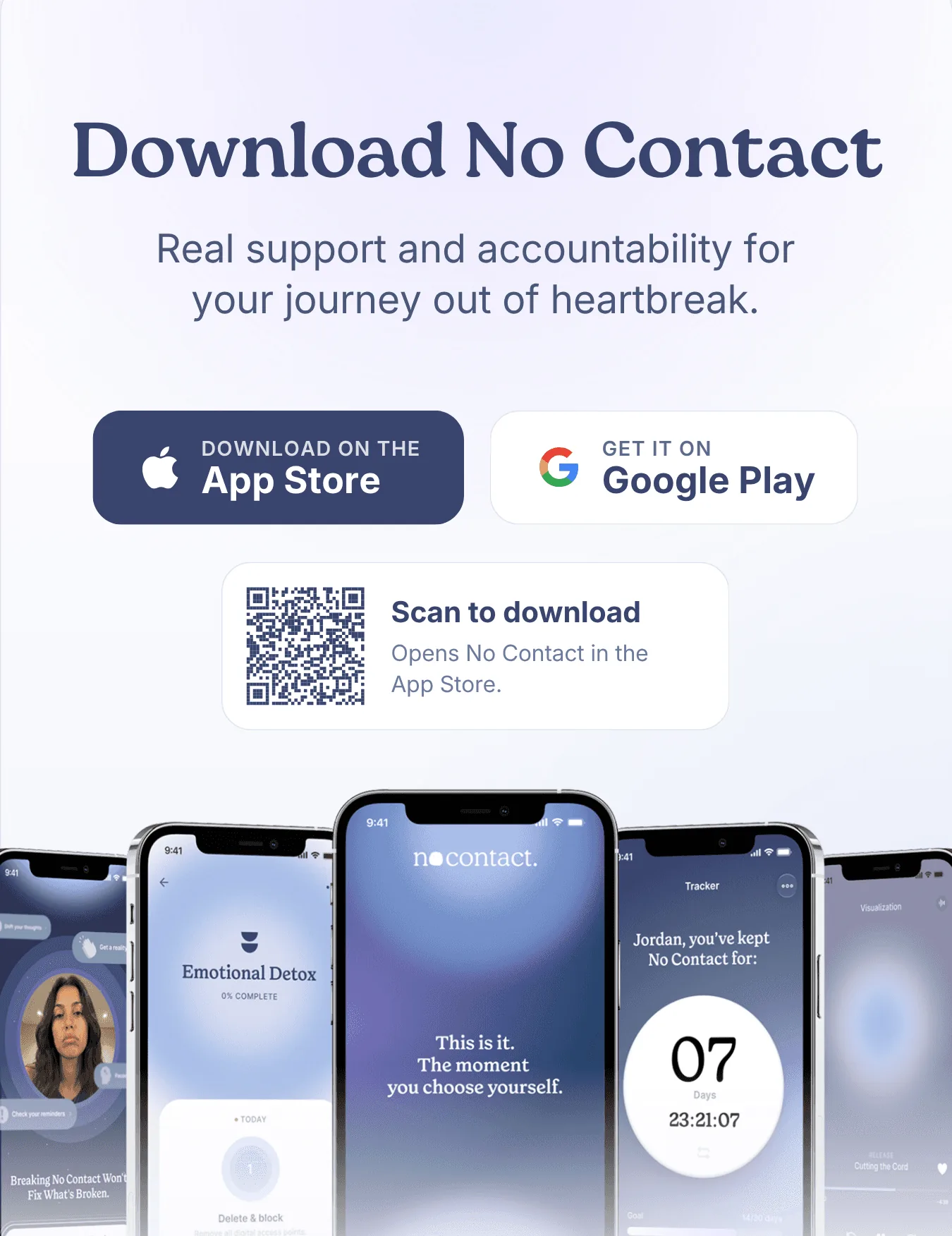
The No Contact app combines several tools designed to support those phases of moving on:
When You Have Something to Say to Your Ex
Unload Here, the app's journal, gives you a private space to write messages you feel tempted to send. You can ask questions that still bother you, explain how the breakup affected you, express anger, or say things you never had the opportunity to say.
Many people reach out to an ex because they feel stuck carrying thoughts that keep replaying in their head. Writing those thoughts down can help you express them without depending on your ex to respond or provide the closure you're looking for.
Nothing gets delivered. You can say exactly what you want to say without creating a conversation that leaves you checking your phone, analyzing replies, or wondering what their response really meant.
When You're Tempted to Break No Contact
The manifesto holds your own no contact rules and reasons, written in your words when your head was clear. It provides a visible record of the commitment you've already made to yourself.
When you're thinking about breaking no contact, it's easy to focus on how you feel in that moment. It's harder to remember the progress you've made over the last few weeks or months. If you're still in the early weeks, it helps to know what no contact after a breakup is like in the first 30 days.
Rereading your manifesto helps bring that commitment back into view. Remembering why you started can make it easier to pause before making a decision that could pull you back into old patterns.
When You Start Remembering Only the Good Parts
The Evidence Vault helps you save reminders of things that are easy to forget once time starts creating distance from the relationship.
You can store screenshots, personal notes, reminders of recurring conflicts, examples of unhealthy behavior, or reflections you wrote when the reasons for the breakup felt clearer.
When Emotions Start Driving Decisions
The app's Panic Room is designed for moments when contacting your ex feels difficult to resist. Instead of relying on willpower, you can access tools designed to help you slow down and work through what you're feeling first.
Its breathing and calm tools help the urge pass, and from there you can review reminders in the Evidence Vault or journal what is on your mind.
When You Need a Different Perspective
The app includes Kai, an AI coach that helps you work through situations that keep taking up space in your mind. This could be mixed signals from your ex, confusion about the breakup, anxiety about moving on, or doubts about whether no contact is the right decision.
Kai helps you examine situations from different angles and challenge conclusions that may be driven more by emotion than reality.
When You're Ready to Focus on Yourself Again
The no contact rule creates distance from your ex. Recovery comes from what you do with that space. Instead of spending all your energy replaying the relationship in your mind, you can use that space to better understand yourself.
The app includes guided programs and a community designed to support that process:
- Emotional Detox helps reduce emotional attachment and break habits that keep pulling your attention back to your ex.
- Self-Love focuses on rebuilding self-worth and confidence after rejection, disappointment, or relationship loss.
- Inner Child Healing helps you explore deeper emotional patterns that may influence who you become attached to and how you respond to relationships.
- Community features connect you with people working through similar experiences.
Frequently asked questions
Is it ever okay to text your ex?
Yes. Practical messages about children, shared things or safety are part of life after some breakups. For anything else, it's worth waiting until you could accept any reply, or no reply, without it setting you back.
What should I do instead of texting my ex?
Write the message somewhere it won't be sent, like a journal or a private note. Then wait a day and reread it. You can also call a friend, step outside or use a grounding exercise until the urge passes. For more ideas, see how to stop thinking about someone.
Will texting my ex make me feel worse?
It often does, even when the reply is kind. A message can restart the cycle of waiting, rereading and analyzing, and pull your attention back to them. If you're trying to heal, read more about why the no contact rule helps.
Give Yourself a Little More Time
If you've been thinking about sending the same message for hours, give yourself a little more time.
You don't have to keep those thoughts bottled up, and you don't have to send them to your ex to express them.
Download the No Contact app today and use Unload Here to express what you're feeling and navigate breakup recovery one day at a time.
What’s your attachment style?Free 2-minute quizStart →